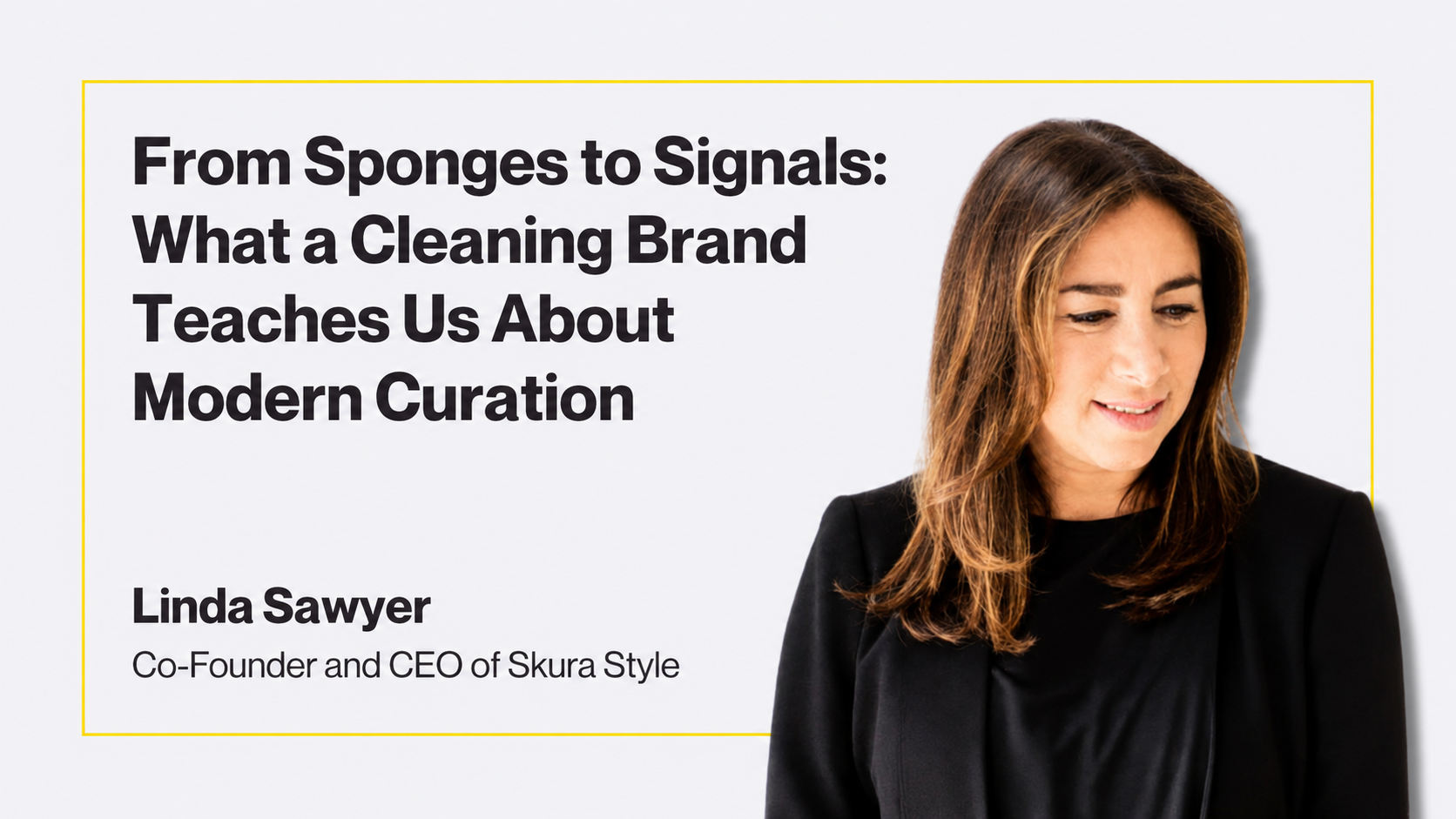
Linda is the co-founder and CEO of Skura Style where she leads the company’s mission to disrupt the household sponge and cleaning category with a line of innovative, award-winning products that are beloved by consumers and the press.
Before launching her company, Linda spent over 30 years in the advertising industry. As North American CEO and Chairman of Deutsch Advertising, she was instrumental in transforming into one of the premier agencies in the industry. She is also a recipient of the NY Women in Communications Matrix Award and was named by Ad Age as one of the ten most powerful women in advertising.
Curation Conversations spoke to Linda about how brands identify and connect with the right audiences - and what that reveals about a broader shift toward more structured, signal-led approaches to reaching consumers across today’s fragmented media landscape.
Can you tell us the story of Skura Style? How did you go from the CEO of a big ad agency to building a product rooted in a clear consumer insight?
I spent my whole career in advertising, but I am a home design enthusiast. I'm also a complete clean freak. Over the decades, the kitchen has experienced so much innovation both in terms of aesthetics and performance. Even completely benign products, like paper towel holders and dish rags and garbage cans, are now beautiful and perform so much better than they used to.
And yet, front and center were these ugly kitchen sponges that were just trapped in time. They were ugly. They only came in industrial colors like green, yellow, blue. But most of all, within a couple of days, they were disgusting.
I shared that insight with my friend and soon-to-be co-founder, Alison Matz and learned that she shared my disdain for sponges. We did some consumer research, which validated what we expected: there is a universal hate affair with traditional kitchen sponges.
Who did you expect your audience to be, and did anything surprise you about how that audience revealed itself over time?
On the one hand, our audience is quite broad because most people own sponges. At the same time, it’s a premium product which we knew would do well with a more affluent, educated consumer. But honestly, the way we look at our core audience goes back to our core insight—it’s the people who are really disgusted with their traditional sponges.
I don’t think anything was a huge surprise because we knew we had a wide audience. I think what may have surprised us is the enthusiasm that we see. We have a lot of influencers—whether they’re in the wellness space, the home design space, or the cleaning space—who talk about our products and hacks with a kind of pride and excitement that almost makes you forget we’re actually talking about sponges.
Speaking of influencers and reach, Eva Mendes is not just partnering with your brand, she is a full business partner. How did you team up with her? And what has the partnership done for your brand?
She came to us, which was terrific. During the pandemic, Eva Mendes, like everyone else, was on 24 hours a day. She had young kids and was in that cook, wash, rinse, repeat cycle we all hated. She loves cleaning and doing dishes but hated her sponges.
She discovered our products and read our backstory and reached out to us. As soon as we met—on Zoom because it was the pandemic—we all knew we were kindred spirits who were passionate about cleaning and design. We kept talking, and she evolved from an obsessed customer into a co-owner and truly hands-on partner.
She’s had an impact on product development and has been critical in helping us develop retail relationships. And as you said, she’s an influencer in her own right with a sizable following, which has certainly extended our reach.
But beyond reach, what has made the biggest difference is her authenticity. When she talks about the product, it’s contagious because she genuinely loves it and uses it every day.
How do you approach partnerships beyond influencers—whether with retailers, other brands, or cultural platforms—to reach the right audience in a more meaningful way?
Our best partnerships are driven by similar brand customer journeys built on disruption and dissatisfaction with current offerings. We look for partners who are also challenging the status quo, because that alignment creates a more authentic connection with the audience.
You were recently rated number one by Wirecutter and saw such a significant surge in demand that you wondered whether you’d actually run out of product. Why do you think that moment resonated so strongly - and what does it say about the role of trusted environments in reaching the right audience?
We’ve had a treasure trove of earned media over the years. We’ve been ranked number one by Good Housekeeping, Bon Appetit, Food and Wine, and Consumer Reports. Whenever we make a list, we get a boost, but this was different.
I think it’s because Wirecutter has an incredibly loyal audience. They like that Wirecutter is very transparent about their testing and vetting process, and they consult it before they make any purchases. Their audience is educated and affluent (remember it’s part of the New York Times), and they like to discover new gadgets and products.
That’s our core audience as well. In a way, the Wirecutter audience was already curated for us.
It feels like there is a lesson in here about reaching the exact right audience within the right environment. How will it inform what you do next?
I agree. The cascade effect of the Wirecutter experience allowed us to tap into what they know about their audience and learn more about our own. We’re now exploring paid opportunities to reach this same audience.
You had a stellar career in advertising that included being North American CEO and Chairman of Deutsch. How do you think your attitudes about identifying and connecting with audiences have changed since moving to the brand side?
I don’t think moving to the brand side has really changed how I think about reaching customers. In many ways, that’s exactly what we were trying to help clients do at Deutsch. A customer-first strategy is what all brands should be doing, no matter where you sit.
At its core, that’s about aligning your brand values with the values of your customers and inviting them into that shared brand culture. For us, a big part of that was recognizing that people felt they were being taken advantage of by being forced to buy an inferior product for years.
We’re curating our audience through a lens of challenging the status quo and rejecting mediocrity. That’s incredibly galvanizing. It doesn’t just help attract customers; it really helps build a community.
What do you think brands are getting wrong in terms of curating their audience and keeping their messages consistent?
Brands aren’t failing because they don’t understand the basics of marketing—they’re failing because their messaging lacks authenticity. Consumers are incredibly savvy; they can spot when a brand is trying to manufacture credibility or cut corners. If you underestimate your audience, you lose them.
A clear example is the rise of celebrity brands. Simply attaching a famous face isn’t enough. It only works when there’s a genuine, relevant connection between the person and the product—when it feels real. Otherwise, it comes across as opportunistic and falls flat.
Brands need to solve real problems and give consumers something meaningfully better than what they already have. They need to give consumers a reason to care.
How do you think about choosing the right channels or environments to reach your audience, especially as options continue to fragment?
It’s very much the old-fashioned test and learn model. Given that there are so many options and that we are very performance focused, we look for channels with rapid response. Then we test and shape our strategy around what we’ve found. It’s an iterative approach, but it ensures we’re meeting our audience where they are in a way that’s both efficient and relevant.
Talking about channels. Have there been any unexpected channels or environments that ended up being especially powerful for your brand?
Yes, entertainment news. When Ryan Gosling talks up your product during a Barbie interview, it’s magic!
You started in this industry before we had so much data available. Do you think brands are too reliant on data these days? How should they be incorporating old-fashioned intuition?
It would be ridiculous to just follow your intuition and ignore the data. Data is enormously helpful because it’s rooted in fact. But data doesn't always have the nuance and can’t give you the emotions behind the numbers.
The right audience is going to be defined by an intersection between their values and needs and how your brand can solve to deliver those things. The magic happens when the right product and the right message find the right audience.
There's an EQ to it that sometimes IQ can't solve for, but once you understand the mindset and values of your consumer, data and technology can get you much closer to that magic intersection that we could have imagined when I was first starting out.
What Linda’s story highlights is that what many brands describe as ‘curating an audience’ often begins much earlier than media activation. Trust, context, and validation - whether through editorial platforms like Wirecutter or authentic advocacy - act as powerful filtering mechanisms long before targeting comes into play.
In programmatic terms, this is where curation evolves: structuring not just who you reach, but where and how that connection happens. As the ecosystem becomes more fragmented, the ability to align high-quality environments, meaningful signals, and audience intent will ultimately help drive performance. Curation, then, is not just about finding an audience - it’s about activating that audience through the right combination of context, quality, and intelligence.


Ⓒ 2026 Curation Conversations. All Rights Reserved.





.png)
.png)

.png)

.png)

.png)

.png)
.png)


.png)
.png)