




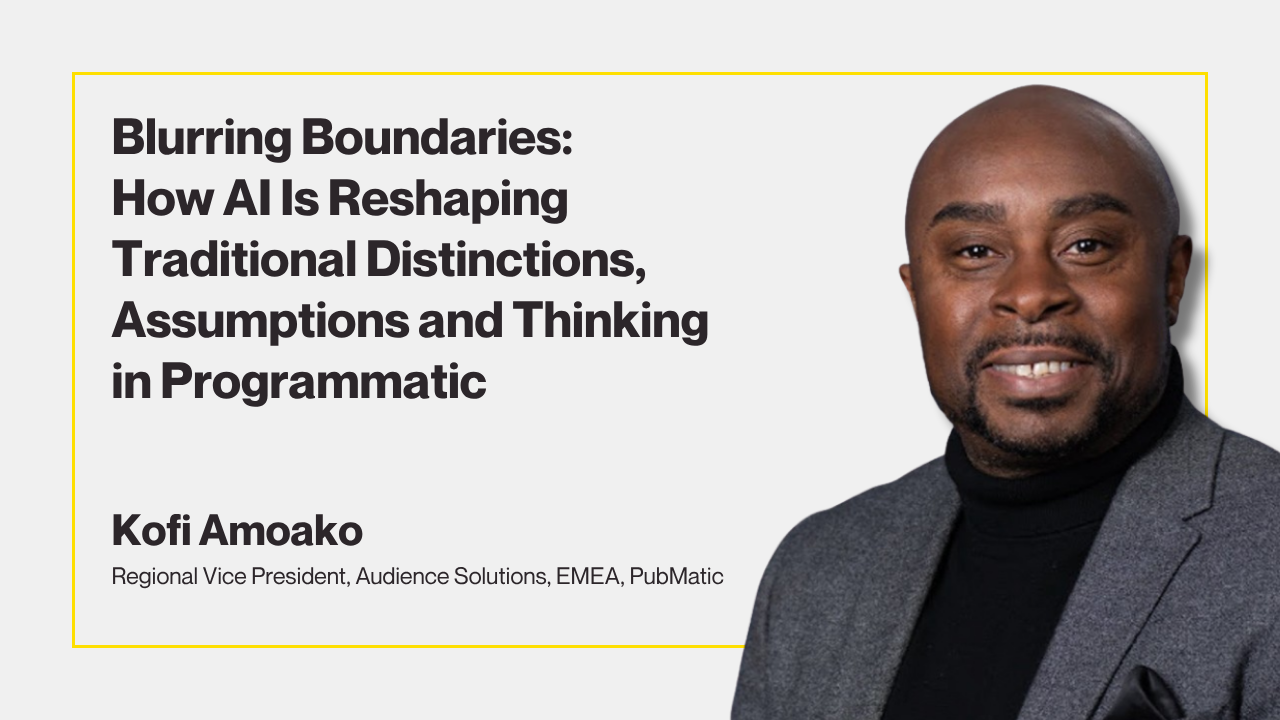
Kofi is Regional Vice President, Audience Solutions, EMEA at PubMatic, bringing over 20 years of experience across media, technology, and digital advertising.
In his role, he leads the company’s audience solutions strategy across the region. Kofi works closely with leading data, curation and identity partners to develop scalable, privacy-first solutions that help publishers and buyers connect with audiences effectively across diverse markets.
Curation Conversations sat down with him to discuss the changing face of programmatic advertising and what the rise of agentic means for media trading, transparency, traditional industry distinctions and how curation is evolving.
Let’s start with curation. Has it changed what buyers should expect from an SSP?
Yes, but for me, curation was never about filtering inventory down. It’s about deciding which inventory has value based on the buyer’s objective then making that decision as close to the inventory as possible. And this raises buyers' expectations.
Traditionally, the job was to match a bid to an impression. Now, curation means the platform shapes which inventory matters for that buyer’s goal. Buyers can expect the platform to take the campaign KPI, not just the targeting brief, and then optimise performance while the campaign is live. That means constantly evaluating which publishers, formats and moments move the campaign towards its objective, then shifting delivery towards those.
For buyers, the practical benefit is fewer wasted options and faster learning. For us, curation is table stakes if you’re serious about serving performance buyers, because you must show what worked and, importantly, why. We’ve been working on this for years. It’s the foundation of everything we’re building with AI now.
So how does PubMatic approach curation, and what’s been the impact on the business?
We approach it in three ways: the data we can see, the models that act on intelligence, and autonomy.
On the data side, we work with over 2,000 premium publishers, covering the top 100,000 sites, apps, and streaming services, while more than 300 data partners feed into the platform. What matters isn’t the numbers, but the signals we see at the point the auction happens, before it’s packaged for a buying platform. That’s what powers smarter curation.
When it comes to intelligence, we’re addressing two areas in a single decision: what the buyer is trying to achieve, and what the publisher’s content and audience offer at that moment. Most platforms see these as separate items, but we see them as one.
And in the case of autonomy, we have over 20 agents on the platform carrying out defined tasks, from finding audiences and building deals to pacing and reporting. These tasks are narrow, and each agent carries them out without a person stepping in, while operating within human-set objectives, budgets and guardrails.
So, what’s the impact? Well, we’ve run over 80 fully autonomous end-to-end campaigns since January, and more than 4,000 AI-powered deals have been transacted. Yes, it’s a fraction of what runs across our platform, but it’s early days, and we’re seeing good potential.
That said, someone still must decide what to optimise for and how to think about inventory. That expertise doesn’t disappear; it moves into the agents themselves. What changes is how it’s delivered. Instead of selling curation as a tool, you’re selling specialised decision-making inside the agent itself.
I mentioned SSP at the start, but does the industry still think in terms of buy-side versus sell-side, or are those traditional distinctions becoming less meaningful?
Yes, they are, and that shift’s accelerating. The traditional model made sense when people were making the decisions. Buyers needed one interface; sellers needed another, and the workflows were built around them.
When execution’s automated, that dependency loosens, and so do the distinctions. The system works towards the buyer’s outcome, so which side of the industry the underlying technology came from matters less.
That thinking is behind our real-time intelligence layer, Decision Fabric. Partners can run their own specialist buying platforms inside our infrastructure, alongside the inventory and the auction, using their own logic in parallel with our data and models.
We’re moving toward collaboration without walls. The old boundaries between buy and sell are less relevant than they used to be. What matters is whether the platform has access to better intelligence and inventory, can make faster decisions and help advertisers achieve their objectives.
And I think the sell side is the natural home for this. After all, we have visibility into the available inventory, not a filtered slice. And because we sit closer to the impression, we’ve more time to make a decision than a buying platform working inside a traditional bid request. But while we’re providing an environment where better decisions happen, how a business prefers to operate comes down to the buyer.
PubMatic is one of the founders of AdCP. What impact is this having on digital advertising, and how are brands benefiting? And when it comes to understanding its impact, what does 'success' look like?
Yes, we’re co-founders and a launch partner of AdCP (Ad Context Protocol), which solves a specific but critical problem: how do agents talk to each other about what matters in a transaction? When two agents transact automatically, they need a shared way of describing what is on offer and what is being asked for.
Protocols were developed for transactions where people set the terms up in advance. But when agents negotiate with each other at speed, you need richer context. What is the buyer trying to accomplish? What does the publisher know about the context? And what are the options? AdCP provides that common vocabulary for the exchange.
While brands don’t use AdCP themselves, they feel its effects. Fewer bespoke integrations, less time between a brief and something running, and a tighter loop between what a campaign is meant to achieve and how the system optimises delivery towards it.
This means adoption speeds up (we’re predicting 25% of media buying will be agentic by the end of 2028), transaction value increases because decision quality improves and the cost of operating at scale comes down for everyone.
There's a lot of talk about containerisation right now. What does this mean to PubMatic? And how do you see it changing the way customers find success in curation?
Containerisation gives partners a sandbox inside our infrastructure. They bring their models, their logic, and their optimisation rules. We provide the processing power to run their models at auction speed, plus the data, inventory, and underlying platform infrastructure. The model runs next to the auction rather than a few steps away, overcoming the traditional constraints around how much traffic a buying platform sees and how many milliseconds it gets.
It also lowers the cost barrier. Building a buying platform from scratch means engineering, infrastructure, data deals, and buyer support. Containers mean a specialist can bring the part they are genuinely good at without rebuilding everything underneath.
For curation, it means the work is more specialised than generic. A model built for retail behaves differently from one for financial services because the outcomes differ. So instead of selling access to a curated deal, you can build the decision-making itself and run it where the inventory is.
It means customers get three things: decisioning transparency, one place to manage the campaign, and the same brand-safe premium inventory we sell everywhere. This lets them confidently scale curation.
Tackling transparency remains an issue in adtech, but with a greater focus on machine-driven trading, do you think these black boxes will make it harder to deliver it?
The opposite, because if you design agentic systems correctly, they can increase transparency.
A human media buyer makes hundreds of decisions every day, guided by intuition, experience, and gut feel. But these decisions aren’t auditable, and you can’t explain why they happened.
However, machine decisions can be recorded in a way human ones usually aren’t. When a system decides, you can log the inputs, the decisions it took and what it was optimising for. It means building proprietary black boxes and refusing to show the logic isn’t an agentic problem; it’s a design one.
At PubMatic, we see transparency as a feature and build for this.
We shipped a reasoning agent this year that sets out why a given decision was made. It includes buyer controls with approval steps before certain actions and a full audit trail of what the system did. More recently, we launched a governance architecture for agentic advertising, covering planning through to activation and measurement. The guardrails sit at the point of execution, in the same infrastructure where campaigns are built and activated, rather than being layered on afterwards.
Regulators, brands and publishers all care about this, and it’s those platforms that make decision-making transparent will thrive.
Do your agents produce better outcomes than campaigns run by humans?
Where we’re seeing gains is around time. Setup can be over 80% faster, which is significant when a trading team’s week is admin heavy.
Level Agency tested our agentic buying against their incumbent DSP. They saw more than twice the reach per dollar on qualified audiences and retargeting live within days rather than the one to two months a DSP ramp usually takes.
On outcomes, a campaign with Havas and Telefónica in Spain came in 18% below its CPM target and over-delivered impressions by 23%. In France, with Amnet, we’ve seen a 26% uplift in video completion rates.
We’re finding that systems are better at repetitive tasks: testing combinations, reallocating spend quickly and reading data at a volume humans can’t. Meanwhile, people are better at deciding what the campaign is for. Where agents add value is by removing the high-friction operational layer around programmatic execution.
Finally, is there an assumption in adtech that you fundamentally disagree with?
Yes, and it’s that intelligence belongs on the buy side.
The assumption is that the DSP is where smart decisions happen because that is historically where the objective and the budget sat. But in an AI-native world, intelligence must sit where the information is most complete and the decision best made, and that’s with the SSP.
We see the full set of available inventory, not just a slice. We see data before it's packaged for a buying platform. And a model running next to the auction has more time to think than one calling in from outside.
This doesn’t mean DSPs disappear; their role just changes. Instead of a monolithic platform, you’ll see specialist platforms, run in containers, focused on specific buyer types, operating inside a powerful sell-side infrastructure.


Ⓒ 2026 Curation Conversations. All Rights Reserved.
.png)
.png)


.png)

.png)

.png)

.png)
.png)



.png)
.png)